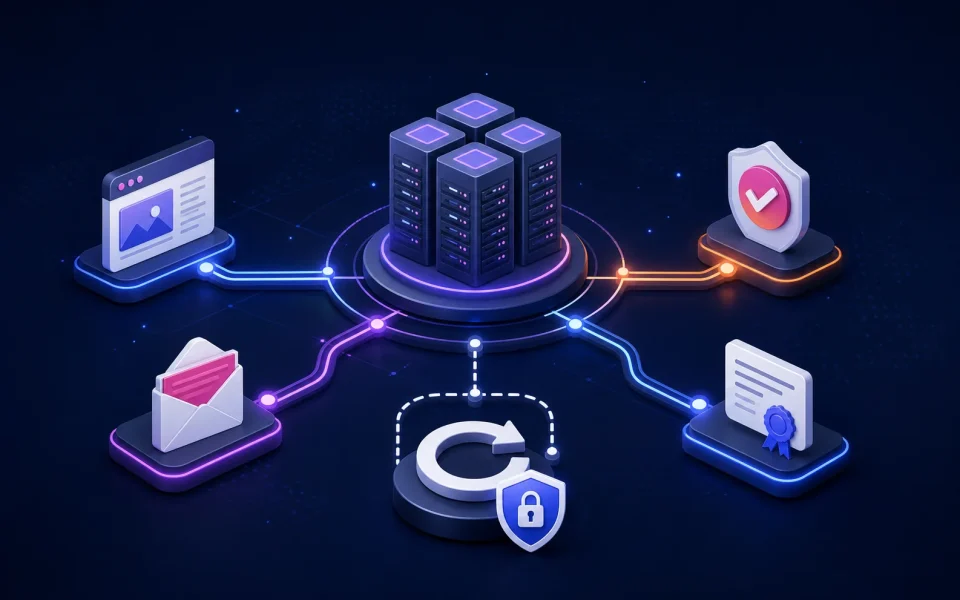
Short answer: CMS access lets someone manage content and software inside the site. It does not automatically control hosting, domain registration, DNS, source repositories, licenses, backups, billing, or contractual ownership.
Why this control question matters
A website is a bundle of relationships rather than one asset. A business can hold a WordPress administrator account while an agency controls the hosting contract, deployment credentials, premium licenses, backups, and DNS.
Separating the layers makes transitions and recovery more predictable. It also prevents teams from overclaiming ownership based on a login that covers only one part of the stack.
Warning signs to investigate
- The business can edit pages but cannot access hosting backups or billing.
- Source code exists only on an agency device or private repository.
- Premium features stop when an agency license is removed.
- DNS and CDN changes require unrelated accounts.
- The restore process has never been tested outside the live host.
A practical review process
- List the domain, DNS, CDN, hosting, CMS, repository, deployment, database, storage, backup, analytics, and license layers.
- For each layer, record the business authority, current administrator, billing owner, recovery path, and evidence.
- Document what is licensed, assigned, transferable, exportable, or dependent on a provider.
- Test that an authorized backup can retrieve a recent backup and understand the restore prerequisites.
- Review the full map during agency, ownership, or platform changes.
Questions to take into the review
What would the business lose if the CMS administrator account were the only credential retained?
Record the current answer, the evidence that supports it, the person responsible for any follow-up, and the date it should be reviewed again. Separate confirmed facts from assumptions so the next operator can understand the decision.
Can the site be restored without the current agency or host?
Record the current answer, the evidence that supports it, the person responsible for any follow-up, and the date it should be reviewed again. Separate confirmed facts from assumptions so the next operator can understand the decision.
Which third-party licenses affect operation or design?
Record the current answer, the evidence that supports it, the person responsible for any follow-up, and the date it should be reviewed again. Separate confirmed facts from assumptions so the next operator can understand the decision.
What a useful record should contain
Keep the asset name, business purpose, authorized owner, current administrators, recovery methods, dependencies, provider-specific limitations, evidence, open exceptions, and last review date together. Do not paste passwords, recovery codes, private keys, or unnecessary personal data into the record.
Next step
Choose one high-impact asset and complete the review before expanding the process. A small verified record is more useful than a large inventory built from assumptions.